How to Read Your Eyeglass Prescription (Plain English)
OD, OS, SPH, CYL, AXIS, ADD, PD -- every field on your eyeglass prescription explained in plain English, with a worked example and common ordering mistakes.
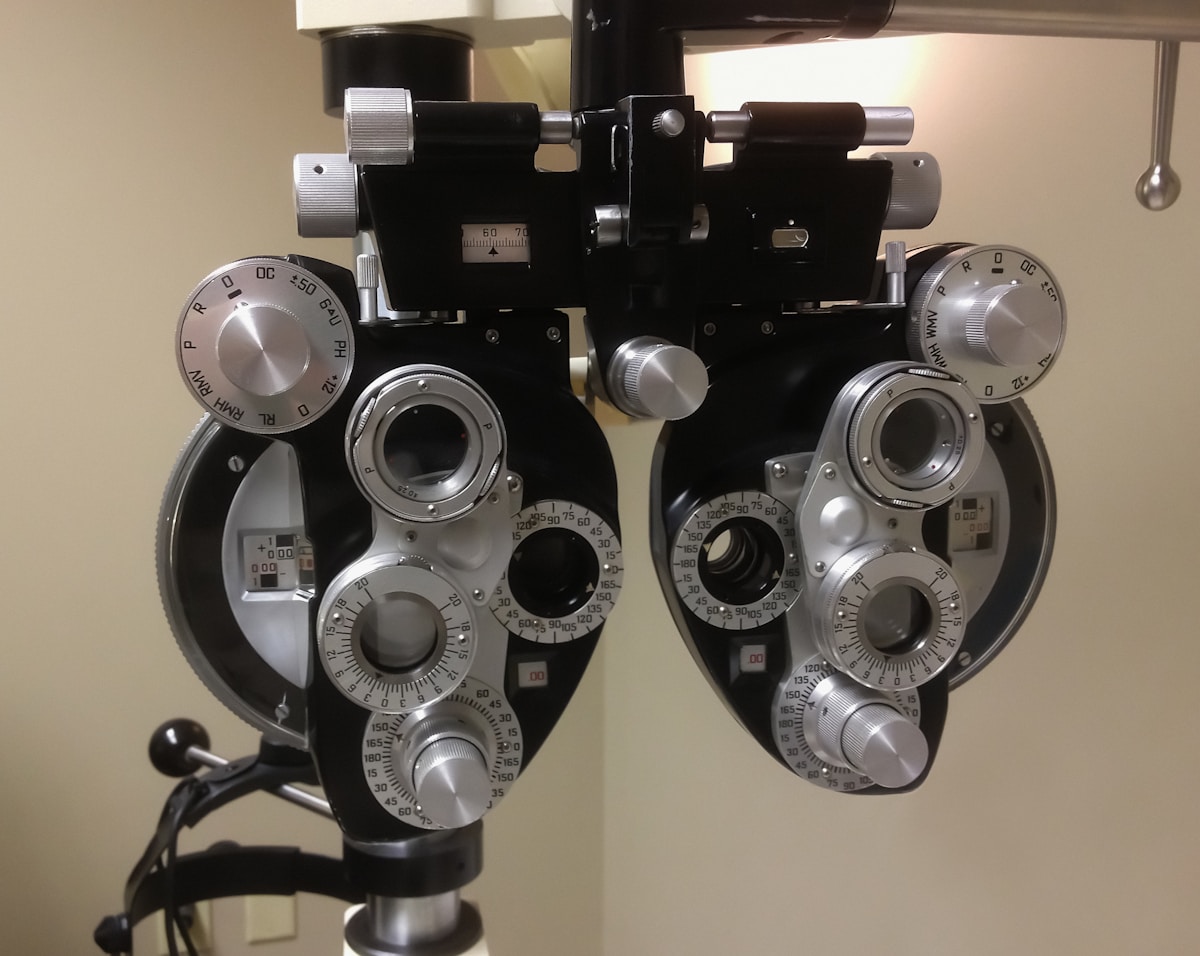
Your optometrist hands you a piece of paper with two rows of numbers and abbreviations. OD. OS. SPH. CYL. AXIS. ADD. PD. For most patients, this looks like a code they were never given the key to. They copy it into an online order form, hope for the best, and worry quietly that they got something wrong.
The prescription is not complicated once you know what each field represents. This guide translates every common field on a standard eyeglass prescription into plain English. By the time you finish, you will be able to read your own prescription, understand what it means for your vision, and know exactly what information you need to order frames online.
OD and OS -- Right Eye and Left Eye
OD stands for oculus dexter, Latin for "right eye." OS stands for oculus sinister, Latin for "left eye." Some newer prescriptions use RE and LE instead, but OD and OS remain the dominant convention worldwide.
Prescriptions are always written OD first, OS second. The top row of a two-row table is always your right eye. This convention has not changed in over a century of ophthalmology, and every optician, lab, and optical retailer follows it.
Occasionally a prescription also lists OU, meaning oculus uterque -- "both eyes." This field appears when a value applies equally to both eyes, which is most commonly the case with ADD.
SPH -- Your Basic Prescription Strength
SPH stands for sphere, and it represents the main corrective power of your lens. It is measured in diopters, written to two decimal places, and can be either a positive or a negative number.
A negative SPH value (for example, -2.25) means you are myopic -- nearsighted. Light entering your eye focuses in front of the retina instead of on it, producing blur at distance. The larger the negative number, the stronger the correction needed. -1.00 is a mild prescription. -5.00 or higher is considered moderate to high myopia.
A positive SPH value (for example, +1.50) means you are hyperopic -- farsighted. Light focuses behind the retina. Mild hyperopia is often compensated naturally by the eye's own focusing mechanism, which is why some farsighted people do not wear glasses until middle age, when that compensating ability begins to fatigue. In children, uncorrected hyperopia can contribute to eye strain and convergence problems.
When SPH reads 0.00 or is listed as "Plano" (sometimes abbreviated PL), no spherical correction is needed in that eye.
CYL and AXIS -- Astigmatism
CYL stands for cylinder, and AXIS is its companion. These two values always appear together because they describe astigmatism, a condition where the cornea or crystalline lens is not perfectly spherical. Instead of curving evenly in all directions like a basketball, an astigmatic cornea curves more steeply in one meridian than another -- more like the surface of a football or a spoon. This uneven curvature focuses light at two different points rather than one, producing blur or distortion at any distance.
CYL is the power needed to correct the astigmatism, measured in diopters. It can be written as a negative or a positive value depending on which notation convention your optometrist uses. Both notations describe the same optical condition, and labs can convert between them. Do not worry if your prescription shows negative CYL and an online form asks for positive CYL, or vice versa -- the conversion is a standard function of any optical lab.
AXIS is the orientation of the astigmatism correction, measured in degrees on a scale of 1 to 180. Because astigmatism is directional, the corrective cylinder must be aligned precisely with the cornea's irregular meridian. A CYL value means nothing without an AXIS to anchor it. If your AXIS is 180, the astigmatism runs along the horizontal. If it is 090, it runs vertically. Values in between represent oblique orientations.
If your CYL field is blank or reads 0.00, you have no measurable astigmatism in that eye, and you will not have an AXIS value either.
ADD -- Reading Addition Power
ADD is the additional plus power applied to the lower portion of a multifocal lens (progressive or bifocal) to assist with near vision. It is always a positive number, regardless of whether your distance SPH is negative or positive.
ADD appears on prescriptions for people with presbyopia -- the gradual stiffening of the eye's crystalline lens that begins in the early to mid forties and reduces the eye's ability to shift focus from distance to near. No amount of glasses can reverse presbyopia itself; ADD corrects the practical result of it by doing the focusing work the lens can no longer do on its own.
The typical ADD range runs from +0.75 for mild presbyopia in early onset patients to +3.00 at the high end for older patients or those with more significant near vision loss. Most first ADD prescriptions fall between +1.00 and +1.50. The ADD value is usually the same for both eyes, since presbyopia affects both eyes symmetrically in most patients, though small differences between eyes are not unusual.
If your prescription includes an ADD, you will need either multifocal lenses (progressive or bifocal) or a separate pair of reading glasses. Your optician can advise on which option fits your lifestyle and prescription best.
PD -- Pupillary Distance
PD stands for pupillary distance -- the measurement in millimeters between the centers of your two pupils. It is used by the optical lab to center each lens's optical correction precisely in front of the pupil. An incorrectly measured or incorrectly applied PD produces prismatic distortion and eye strain, even when the prescription itself is accurate.
PD can be written as a single number (for example, 64) representing the binocular PD measured across both eyes simultaneously. It can also be written as two numbers separated by a slash (for example, 32/32 or 31.5/33) representing the monocular PD, measured from the center of the nose bridge to each pupil individually. Monocular PD is more precise and is preferred for progressive lenses and for any patient whose face is not perfectly symmetrical.
One important note: PD is not always included on a printed prescription. Optometrists in most US states are legally required to give you your prescription if you ask, but they are not always required to measure and include PD by default. If PD is not printed on your prescription, ask for it before you leave the exam. Most practices will measure it at no charge. It is a simple millimeter measurement that takes about 30 seconds.
If your PD is not available and you cannot get it from your optometrist, a close approximation can be made at home using a ruler and a mirror, though professional measurement is always preferable for precision prescriptions.
DS -- Diopters Sphere (No Astigmatism)
Some prescriptions write "DS" in the CYL field instead of leaving it blank or writing 0.00. DS stands for diopters sphere, and it means the prescription is purely spherical -- no astigmatism correction is needed in that eye. It is just a notation convention, and it means the same thing as a blank CYL field. If you see DS, you do not have astigmatism in that eye.
Sample Prescription -- Worked Example
Here is a realistic prescription for a 48-year-old with moderate myopia, astigmatism in one eye, and early presbyopia requiring reading glasses:
| SPH | CYL | AXIS | ADD | |
|---|---|---|---|---|
| OD (Right) | -2.25 | -0.75 | 170 | +2.00 |
| OS (Left) | -1.75 | -0.50 | 005 | +2.00 |
Reading this prescription:
The right eye is moderately nearsighted (-2.25) with mild astigmatism (-0.75 at 170 degrees). The left eye is also nearsighted (-1.75) with mild astigmatism (-0.50 at 5 degrees). Both eyes require a reading addition of +2.00, which means multifocal lenses are required -- either progressive or bifocal. The PD should appear separately on the prescription; if it is not listed, ask the optician to add it before you leave the office.
This is a straightforward moderate prescription, compatible with all standard lens materials and lens types, including progressives. The -0.75 and -0.50 astigmatism corrections are mild and will not restrict frame choice.
What You Do NOT Need a Prescription to Order
If you are shopping for frames only -- no prescription lenses -- you do not need a prescription at all. Frame sizing is based on measurements of your face: head width, bridge width, and temple preference. None of that is optically related to your vision prescription.
When you order frames from eGlasses.ca, you are ordering the frame hardware only. Your optician fits the lenses. That means you can browse, choose, and order based on style, size, and face shape without needing your prescription in hand.
If you are ordering prescription lenses to be filled elsewhere, you will need two things: a valid prescription (typically valid for one to two years depending on your state) and your PD. You do not need your optometrist's approval to shop wherever you choose.
Common Mistakes When Reading a Prescription
Confusing OD and OS is one of the most frequent errors. The two eyes often have different prescriptions, and transposing them produces a lens that does not correct either eye accurately. Always confirm: top row is right eye, bottom row is left eye.
Misreading the sign on SPH is another common problem. -2.50 and +2.50 are not interchangeable. A nearsighted prescription entered as farsighted (or vice versa) will produce a lens that actively worsens your vision.
Omitting AXIS when a CYL is present will cause the order to be rejected by any competent optical lab, or worse, produce a lens that does not align the astigmatism correction correctly. CYL and AXIS must always be entered as a pair.
Forgetting that ADD is additional, not the full reading prescription, is a subtler mistake. The full near-vision power of a multifocal lens is the SPH plus the ADD -- not the ADD alone. Your optician handles this calculation when surfacing the lens; you do not need to do the math yourself, but understanding it prevents confusion when reading the numbers.
Finally, using an expired prescription is a mistake that can result in a poor visual outcome and an order you cannot get refunded. Check the date before you order. If your prescription is more than two years old, schedule a new exam.
Ready to shop? Browse our designer frames -- no prescription required.